

2026 R&D Tax Deduction Changes: What U.S. Businesses Need to Know
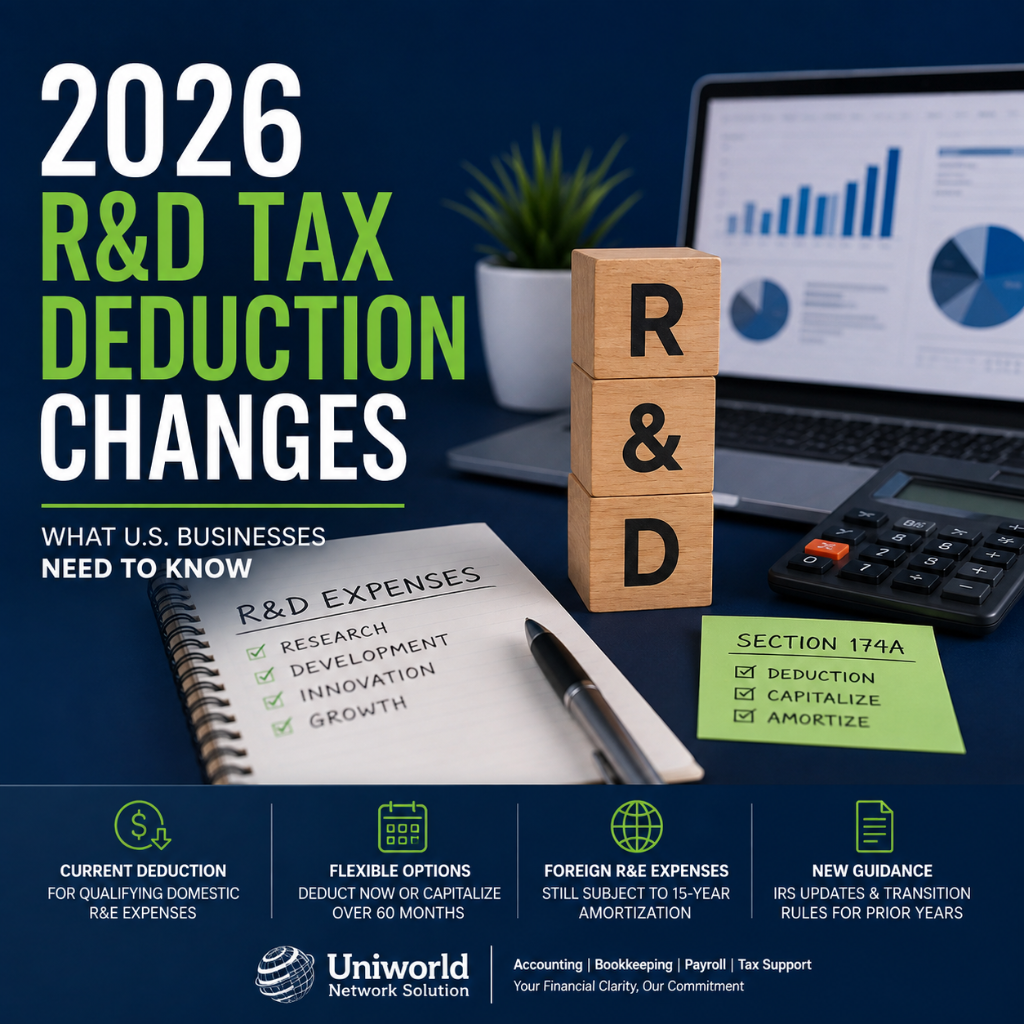
New IRS Rules for Research and Experimental Expenses
Tax rules (2026 R&D tax deduction) for research and development expenses have changed significantly, creating new opportunities for many U.S. businesses.
The One Big Beautiful Bill Act (OBBBA) changed the federal tax treatment of domestic research and experimental (R&E) expenditures for tax years beginning after December 31, 2024. Under the new rules, eligible domestic R&E expenses may generally be deducted currently rather than being required to be amortized over five years under the previous rules.
For businesses that invest in software development, product development, engineering, technology, and other qualifying research activities, understanding these changes can be important for tax planning, bookkeeping, and financial reporting.
At Uniworld Network Solution, we provide accounting, bookkeeping, payroll, finance, and tax support services to U.S. businesses. This guide explains the key R&D tax changes and what business owners should review with their accounting and tax professionals.
What Changed With R&D Expenses in 2026?
Under the previous rules introduced by the Tax Cuts and Jobs Act, specified research and experimental expenditures generally had to be capitalized and amortized over five years for domestic research and 15 years for foreign research.
The 2025 tax legislation changed this treatment.
For tax years beginning after December 31, 2024, Section 174A allows a deduction for qualifying domestic research and experimental expenditures paid or incurred during the tax year. Businesses can also elect to capitalize and amortize qualifying domestic R&E costs over a period of at least 60 months.
This change can have a significant impact on a company’s taxable income and cash flow.
What Are Domestic Research and Experimental Expenses?
R&E expenses can include certain costs related to developing or improving products, processes, software, and technology.
Potential examples include:
- Software development
- Product development
- Engineering activities
- Experimental design
- Technical testing
- Prototype development
- Certain employee wages related to qualifying research
- Certain supplies used in research activities
Not every expense associated with innovation automatically qualifies. Businesses need to properly identify and document qualifying costs.
The IRS specifically notes that domestic software development expenditures can fall within the R&E rules.
How the New 2026 R&D Tax Deduction Can Help Businesses
The biggest potential advantage is improved tax timing.
When qualifying domestic R&E expenses are deductible in the current year, a business may be able to recognize the deduction sooner than under the former five-year amortization approach.
For example, suppose a technology company has $200,000 of qualifying domestic R&E expenditures during a tax year.
Under the current Section 174A deduction method, the company may generally be able to deduct qualifying domestic R&E expenses in the year incurred, subject to the applicable rules.
This could reduce taxable income for that year and potentially improve cash flow.
However, businesses should not assume that every technology or product-development expense automatically qualifies. Proper analysis and documentation remain essential.
What About R&D Expenses From Previous Years?
This is one of the most important areas for businesses that previously capitalized domestic R&E expenses.
The legislation provides transition options for certain domestic R&E expenditures paid or incurred in tax years beginning after December 31, 2021, and before January 1, 2025.
Certain eligible small business taxpayers may elect to apply the new treatment retroactively to those earlier years. There are also options for recovering remaining unamortized amounts.
This means businesses that previously reported R&D expenses under the old Section 174 rules may want to review their prior tax returns and accounting records.
A tax professional should determine whether a business qualifies for a transition election and which method produces the appropriate result.
What Happens to Foreign R&D Expenses?
The treatment of foreign research expenses is different.
The OBBBA amended Section 174 so that the continued capitalization and 15-year amortization rules generally apply to foreign research or experimental expenditures for amounts paid or incurred in tax years beginning after December 31, 2024.
Therefore, businesses with both U.S. and foreign research activities need to carefully separate domestic and foreign R&E expenses.
This is particularly important for companies that:
- Have U.S. headquarters
- Employ developers overseas
- Operate international R&D teams
- Outsource software development internationally
- Maintain foreign subsidiaries
Accurate accounting records can make this analysis significantly easier.
2026 R&D Tax Deduction vs. R&D Tax Credit
Businesses should understand that the R&D deduction and R&D tax credit are not the same thing.
The R&D tax deduction concerns the treatment of qualifying research and experimental expenditures.
The Research Credit under Section 41 is a separate tax incentive for qualifying research activities.
A business may potentially have opportunities involving both, but specific rules apply to calculating and claiming each benefit.
The IRS also updated Form 6765 instructions. For tax years beginning after 2025, certain business component information in Section G becomes mandatory, subject to the applicable requirements.
This makes accurate R&D documentation even more important for businesses claiming the research credit.
Which Businesses Should Review These Changes?
The changes may be particularly relevant to businesses that spend significant amounts on innovation and development.
Examples include:
Technology Companies
Software companies and technology startups often have substantial developer and engineering expenses.
SaaS Businesses
Software-as-a-Service companies may incur significant costs developing and improving software platforms.
Manufacturing Companies
Manufacturers may conduct research involving product design, prototypes, processes, and testing.
Engineering Firms
Engineering companies may incur qualifying research expenses while developing new products or processes.
Biotech and Life Sciences
Businesses developing new technologies, products, or processes may have significant research expenditures.
Startups
Early-stage businesses may benefit from reviewing R&E costs carefully, particularly when they have historically capitalized development expenses.
Why Bookkeeping Matters for R&D Tax Planning
Accurate bookkeeping is essential when identifying and documenting R&D expenses.
Businesses should maintain detailed records of:
- Employee wages
- Contractor costs
- Software development expenses
- Supplies
- Research-related purchases
- Project expenses
- Development activities
- Research locations
- Accounting classifications
Poor bookkeeping can make it difficult to determine which expenses qualify.
For example, a company may have several developers working on different projects. Without project-level records, it may be difficult to distinguish qualifying research activities from routine administrative or operational work.
Common R&D Accounting Mistakes
1. Treating Every Software Expense as R&D
Not every software-related cost qualifies as research or experimental expenditure.
Businesses should analyze the nature and purpose of each expense.
2. Failing to Separate Domestic and Foreign Costs
International businesses need accurate records showing where research activities were performed.
3. Ignoring Prior-Year R&E Balances
Businesses that previously capitalized domestic R&E expenses may have remaining unamortized amounts that need to be reviewed under the transition rules.
4. Poor Documentation
A business should maintain sufficient documentation supporting its R&D activities and expenses.
5. Mixing R&D With General Operating Expenses
Accurate account classifications make tax preparation and financial reporting easier.
How Businesses Should Prepare for R&D Tax Changes
Businesses can take several practical steps.
Review Your 2024 and 2025 R&D Records
Determine how research expenses were treated under previous tax rules and whether transition provisions may apply.
Separate Domestic and Foreign Research
Create appropriate accounting categories for domestic and foreign research expenses.
Review Payroll
Identify employees whose work may be connected to qualifying research activities.
Review Contractor Expenses
Analyze payments to contractors involved in eligible development activities.
Maintain Project Documentation
Keep records describing the purpose, activities, costs, and results of development projects.
Coordinate Bookkeeping and Tax Preparation
Your bookkeeping records should support the information reported on your federal tax return.
What Should Small Businesses Do Now?
If your company has R&D expenses, don’t wait until the end of the tax year to review them.
A better approach is to establish an ongoing process for tracking research-related expenses.
Your accounting team can create separate accounts for:
- R&D payroll
- R&D contractors
- Research supplies
- Software development
- Prototype costs
- Testing expenses
- Other qualifying development costs
This creates a cleaner audit trail and makes year-end tax analysis more efficient.
How Uniworld Network Solution Can Help
At Uniworld Network Solution, we help U.S. businesses maintain accurate financial records and improve their accounting processes.
Our services include:
- U.S. Bookkeeping
- Business Accounting
- Financial Reporting
- Payroll Processing
- Accounts Payable
- Accounts Receivable
- Bank Reconciliation
- 1099 Preparation
- Tax Preparation Support
- Tax Compliance Support
- R&D Expense Tracking
- Management Reporting
- Virtual Accounting Services
Our bookkeeping professionals can help organize your financial data so your tax professional has cleaner and more reliable records when evaluating deductions and tax opportunities.
Frequently Asked Questions
Can businesses deduct R&D expenses in 2026?
Generally, qualifying domestic research and experimental expenditures for tax years beginning after December 31, 2024 may be deducted under Section 174A. Businesses may alternatively elect to capitalize and amortize qualifying domestic expenses over at least 60 months. Specific eligibility and accounting-method rules apply.
What happened to the old Section 174 rules?
The OBBBA changed Section 174 and added Section 174A. Foreign R&E generally remains subject to 15-year amortization, while qualifying domestic R&E has new deduction and capitalization options.
Can businesses recover previously capitalized R&D expenses?
Certain taxpayers may qualify for transition options involving domestic R&E expenses from tax years beginning after December 31, 2021 and before January 1, 2025. Eligibility and election requirements should be reviewed carefully.
Does the R&D deduction replace the R&D tax credit?
No. The deduction and the research credit are separate tax provisions. Businesses should evaluate whether they qualify for the research credit in addition to determining the appropriate treatment of R&E expenses.
Should startups review their R&D expenses?
Yes. Startups and technology businesses that spend heavily on product development, software development, engineering, or experimentation should review their accounting records and tax treatment.
Final Thoughts
The 2026 tax landscape provides important opportunities for businesses that invest in research, development, and innovation.
The biggest change is the new treatment of qualifying domestic R&E expenses under Section 174A, which generally allows current deductions for tax years beginning after December 31, 2024, while providing an alternative capitalization and amortization method. Businesses may also have transition options for certain previously capitalized domestic R&E expenses.
However, the rules can become complicated when a business has foreign research activities, prior-year R&E balances, multiple development projects, or potential research tax credit claims.
Accurate bookkeeping is therefore an important part of effective tax planning.
Uniworld Network Solution provides professional U.S. accounting, bookkeeping, payroll, and financial support services to help businesses maintain organized records and prepare for tax compliance.
If your business has software development, product development, engineering, or other research expenses, reviewing your accounting records now may help you identify tax opportunities and avoid reporting problems later.